What diminishing returns look like during a run
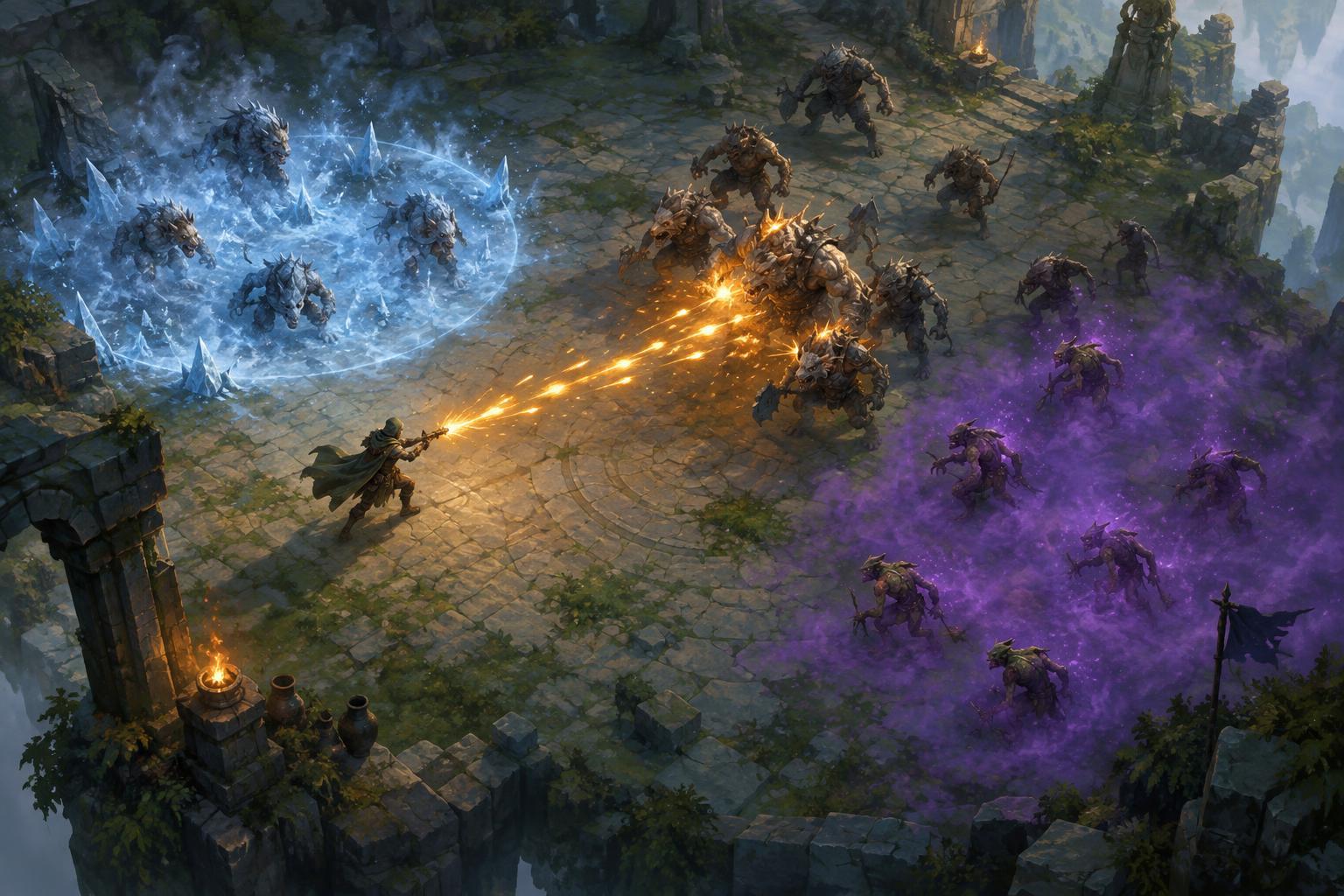
A build often starts with an obvious priority: more damage clears enemies sooner, more speed creates room to dodge, or more health buys time after a mistake. Early upgrades to that stat can solve a problem you feel immediately. Later upgrades may still improve the number on the screen without changing the outcome. If an enemy already falls in one hit, a small damage increase may not help against that enemy at all.
That is practical diminishing return: the next upgrade does less for your run than an alternative would. It does not necessarily mean the game reduces the stat’s numerical effect. A bonus can remain perfectly consistent while becoming less useful because your build has crossed a threshold, another weakness has become more urgent, or the stat has stopped affecting the situations that matter.
Separate the displayed number from the useful result
Start by asking what a stat lets you do, not just how high it can go. Damage may matter when it reduces the number of attacks needed to defeat a sturdy enemy. Attack speed may matter when it keeps a path clear between waves. Movement speed may matter until you can reliably leave danger, after which control or durability could be more valuable. These effects depend on the game’s rules and your current build.
Watch for breakpoints: points at which a small increase changes an outcome. Going from two hits to one is easy to notice. Adding damage while enemies still require the same number of hits may produce a smaller benefit, though it could still help against bosses or later waves. The same reasoning applies to defensive stats. Extra health is most valuable when it lets you survive a hit that would otherwise end the run; beyond that, avoiding hits may be the better investment.
Check how upgrades combine
Similar-looking bonuses do not always stack in the same way. Some games add bonuses together, some multiply different effects, and some impose caps or convert a displayed value into an action at fixed intervals. If the rules are unclear, avoid assuming that a percentage on one upgrade has the same impact as an identical percentage on another. Compare what happens in play: how quickly enemies fall, how often attacks occur, and whether you can maintain safe positioning.
Also consider what the stat needs in order to work. More attack speed may offer little if attacks rarely find targets. A wider attack area may not help if your damage cannot clear the enemies it reaches. Conversely, combining moderate improvements across damage, reach, and coverage can make each one more useful. The aim is not to spread upgrades evenly; it is to identify the part of your build that currently limits its performance.
Use opportunity cost as your decision rule
Every upgrade choice closes off another choice, at least for now. When offered another point in your strongest stat, compare it with the best available answer to your current problem. If ordinary enemies disappear quickly but ranged threats keep trapping you, another damage upgrade may be less valuable than mobility, area control, or a defensive option. If you are safe but cannot finish tougher targets, the balance may tilt back toward offense.
Think in terms of the next few minutes rather than an ideal final build. A bonus that would be excellent with several future upgrades might not help you survive the next difficult wave. On the other hand, a build-defining combination can justify taking a modest upgrade now if you have a realistic way to complete it. Be wary of treating that possible payoff as guaranteed.
Run a simple check before stacking again
After taking an upgrade, look for an observable change. Are common enemies defeated faster? Do you have more room to move? Did a dangerous encounter become easier to manage? If the answer is consistently no, pause before taking the same stat again. You do not need exact calculations to notice that an upgrade is no longer solving the problem in front of you.
A useful habit is to name your build’s bottleneck at each decision: damage, coverage, mobility, survivability, or consistency. Then pick the upgrade most likely to ease it. Reassess as the run changes, because a stat that has diminishing returns now may become valuable again against different enemies or with a new ability. Strong builds are not simply stacks of large numbers; they turn upgrades into reliable answers to the challenges that actually appear.