Randomness should create decisions, not replace them
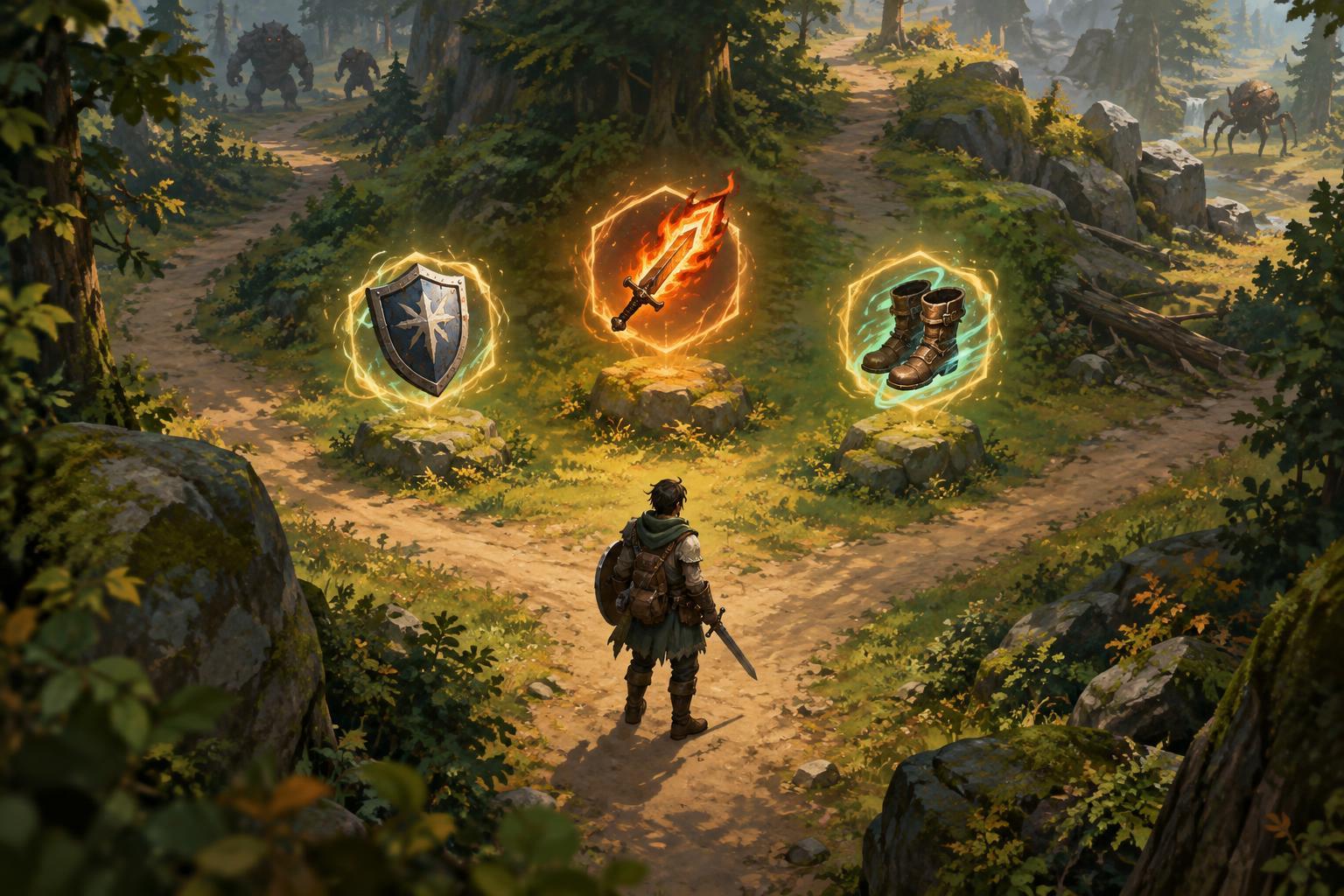
In many survival and roguelite games, a level-up pauses the action and presents a small selection of upgrades. The draft introduces uncertainty: players cannot count on seeing the same choices every run. That uncertainty is useful when it pushes them to adapt. It becomes frustrating when one option is plainly superior or none of the options can meaningfully help.
Agency does not require a player to receive the exact upgrade they want. It requires the available choices to support distinct plans. An immediate damage boost might help survive the next wave, while an area increase may serve a build that already attacks often. Both can be appealing for different reasons. A good draft asks players to judge their current position, not merely recognize the strongest item on a fixed list.
Make each option readable in context
Upgrade descriptions should tell players what will change in terms they can use. “Increases attack area” is easier to assess when the game clearly shows which attacks it affects. If an upgrade has a condition, such as working only at close range or after a critical hit, that condition should be visible before selection. Players can accept a risky choice; they should not have to guess what they are choosing.
Context matters as much as wording. A modest defensive upgrade may be valuable to a player who is barely surviving, but less attractive to someone safely clearing the screen. Designers can help players make that judgment by keeping health, current weapons, and relevant traits easy to review during the draft. The interface need not recommend a choice. It should provide enough information for the player to form a reason for choosing one.
Offer variety without filling the draft with dead ends
A random pool needs enough breadth to produce surprising combinations. It also needs guardrails. An upgrade that affects a weapon the player does not own may be interesting if that weapon is a plausible future pickup. If there is no realistic path to using it, the option occupies space without presenting a useful decision. Eligibility rules can prevent such mismatches while still allowing unusual builds to emerge.
The mix of choices can also vary by purpose. A draft might include an option that strengthens an existing tool, one that opens a new direction, and one that addresses an immediate weakness. This is not a formula every screen must follow. It is a way to check whether players are choosing among strategies rather than among differently named versions of the same benefit. If every offered upgrade only increases damage, the draft may be random but the decision is narrow.
Give players limited ways to steer and recover
Rerolls, skips, bans, or a limited choice of starting equipment can give players influence over a random draft. Their limits matter. Unlimited rerolls can turn uncertainty into a search for the same preferred build; no correction at all can make a run depend too heavily on early luck. A small steering resource creates another decision: use it now to pursue a synergy, or save it for a later draft when the build’s needs are clearer.
Recovery is especially important after a player commits to a direction. If an early upgrade encourages a close-range build, later drafts should offer some reasonable ways to support or revise that commitment. The game need not promise a complete combination. It can, however, provide broadly useful upgrades so a missed piece does not make every subsequent choice feel irrelevant. Players are more willing to experiment when an imperfect pick does not silently end the run.
Test the decisions players actually make
A practical way to review a draft is to pause at several points in a test run and ask: Why would a player pick each option here? If two options have clear, situational answers and the third has none, the third may need a stronger effect, a clearer description, or different eligibility rules. Repeat the check with weak and strong builds. An option that feels fair in a successful run may be useless when a player needs help surviving.
Accessibility belongs in that review. Readable text, distinct icons, and controls that allow unhurried inspection help players compare options rather than rush through them. Clear feedback after selection also lets them learn whether an upgrade did what they expected. This is unofficial editorial discussion of game design, not guidance for any particular game’s official rules. The general goal is straightforward: let randomness propose the problems, while players retain meaningful ways to answer them.