Start with what your main attack already does
A tempting status upgrade can be a poor fit if your main damage source already handles the same job. Before choosing one, describe your attack in simple terms: Does it hit one target or many? Does it strike rapidly or in occasional bursts? Does it reach across the screen, or require enemies to get close? Then identify the situations in which it falls short.
A fast, low-damage attack may clear small enemies reliably but struggle against durable targets. A powerful area attack may erase crowds yet leave you exposed between hits. A short-range weapon may deal enough damage but need help keeping enemies at a safe distance. The best complementary effect addresses one of these gaps rather than merely adding another impressive-looking number.
Status rules vary between games, so treat these examples as a framework, not a universal ranking. This is independent editorial guidance, not an official guide to any particular game.
Match the effect to your hit pattern
Damage-over-time effects, such as poison or burning, often suit attacks that can apply them to many enemies or refresh them consistently. A wide, frequent attack may spread an effect through a crowd while you move on. With a slow single-target attack, the same effect might reach too few enemies to matter. Check whether repeated hits stack the effect, refresh its duration, or do neither; that rule changes the value of attack speed.
Effects that make enemies take more damage can pair well with a reliable opener followed by a heavy hit. If your main attack is the heavy hit, however, ask whether the effect applies before that hit deals damage or only afterward. Stuns and knockback can give a close-range build breathing room, but they may also push targets out of a narrow attack path. Slows are often easier to use with aimed or delayed attacks because they make enemy movement more predictable.
Think in terms of coverage, not just damage
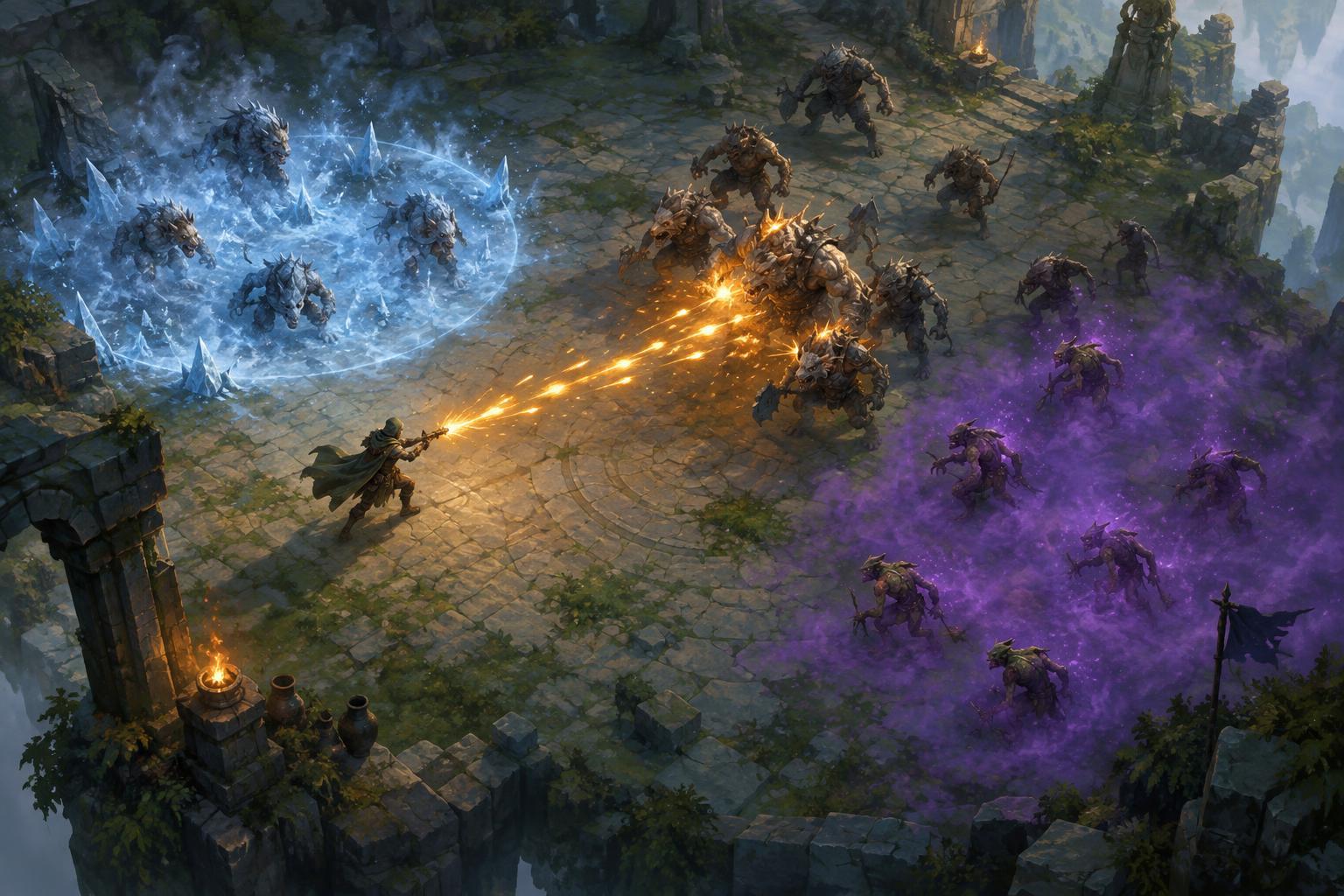
A build needs to survive ordinary waves as well as tougher enemies. If your main damage clears crowds, consider an effect that helps against resilient targets, provided it can be applied to them consistently. If your main attack focuses on one target, a secondary area effect or crowd-control effect may keep surrounding enemies from closing in. This is a coverage decision: you are spending an upgrade slot to handle a threat your primary weapon handles poorly.
Defensive value also depends on how you move. A slow might buy time to escape a dense group, while a brief stun could create an opening to cross a dangerous gap. Neither automatically improves your build if enemies are already dying before they reach you. When choosing between two effects, consider the situation that most often ends your runs, not just the target that is easiest to test.
Account for uptime and opportunity cost
An effect is only useful when it is active on the enemies that matter. Compare its duration, chance to apply, attack frequency, and number of targets reached. A strong effect with rare application may be less dependable than a modest one you can maintain. Likewise, an effect that triggers on defeated enemies may help clear chains of weak targets but do little against a lone durable enemy.
Every status upgrade also competes with direct damage, attack speed, range, mobility, or defense. If enemies already die in one hit, adding damage over time may not change the outcome. If you cannot stay alive long enough to land your attacks, a control effect may be more valuable than another damage increase. Look for upgrades that change what your build can do, rather than upgrades whose benefits rarely have time to appear.
Test a pairing with one clear question
When trying a new combination, keep most of your build familiar and change one status choice. Before the run, set a question: Does slow make a delayed attack land more often? Does poison help finish durable enemies after you disengage? Does knockback protect you, or does it scatter targets beyond your effective range? Watching for a specific result makes the experiment more useful than judging the build only by how long the run lasts.
If the pairing disappoints, check why. The effect may apply too rarely, target the wrong enemies, overlap with damage you already have, or conflict with your movement. That does not mean the effect is universally weak. It may work better with a different hit pattern. A dependable build usually comes from choosing effects for the problems they solve, then adjusting when those problems change.